- 中文
- English
- Español
Rating Criteria for the Proportions of Round Brilliant Cut Diamonds
2023-04-26 23:22:35
Click:
“
On the issue of the proportion of round diamonds, there is no common standard that everyone agrees on. In different countries and regions, the standards implemented in diamond grading are different, so there are many "ideal cuts".
”
In the evaluation content of round brilliant cut diamonds, the evaluation of degree of modification (including facet symmetry and polishing quality) is not controversial, and the focus of controversy is mainly on the proportion of round diamonds (including table width ratio, Height ratio, girdle-thickness ratio, pavilion-depth ratio, culet ratio, total depth ratio, star facet length ratio, lower girdle length ratio). On the issue of the proportion of round diamonds, there is no common standard that everyone agrees on. In different countries and regions, the standards implemented in diamond grading are different, so there are many "ideal cuts".
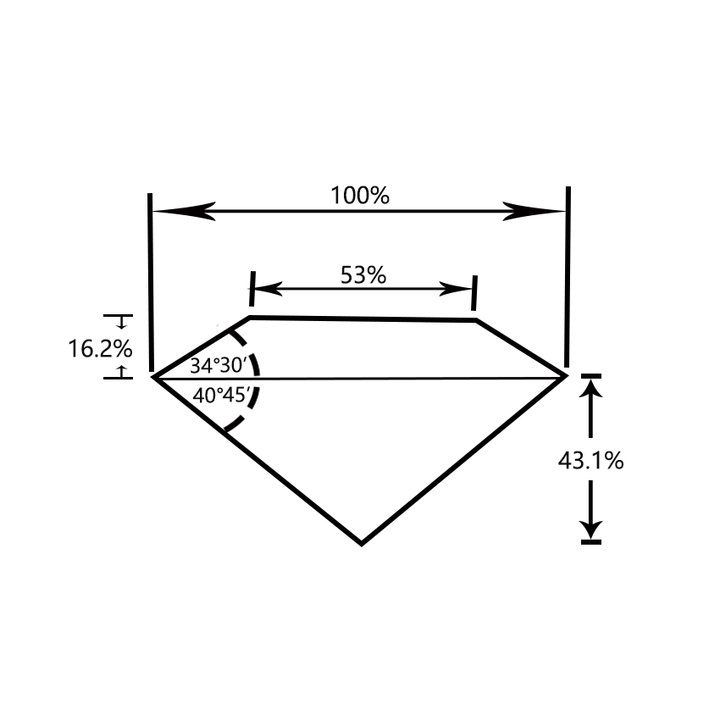
1. American Ideal Cut The American Brilliant Cut was designed in 1919 by American Marcel Tolkowsky, the founder of the modern round brilliant cut, through mathematical calculations based on optical principles. The standard proportions are: platform width ratio 53%, crown height ratio 16.2%, crown angle 34°30', pavilion depth ratio 43.1%, pavilion angle 40°45'.
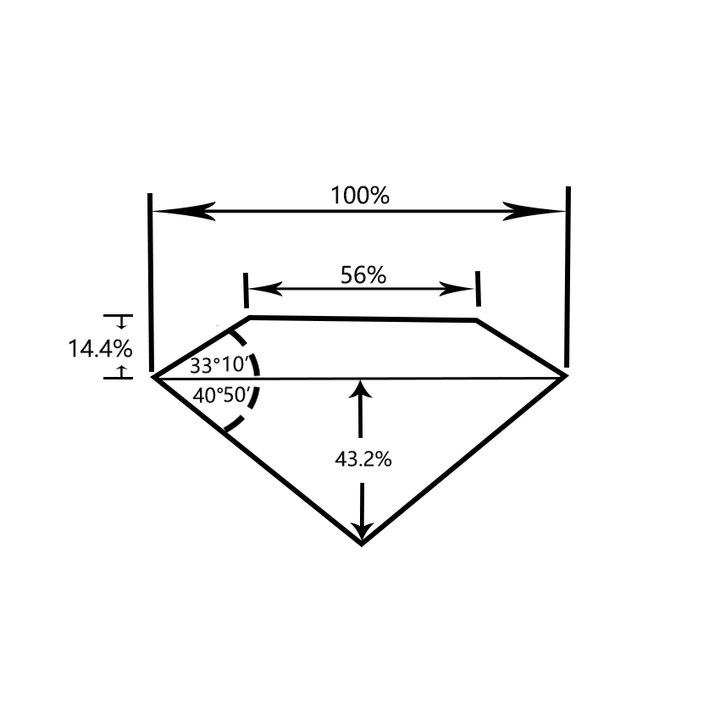
2. Practical perfect cut Practical Fine Cut was designed and invented by German W.E. Eppler in 1949. The standard proportions are: platform width ratio 56%, crown height ratio 14.4%, crown angle 33°10’, pavilion depth ratio 43.2%, pavilion angle 40°50’. At present, in Europe, diamonds of better quality are mostly processed into this cut shape. Therefore, this cut is also known as the European Fine Cut.
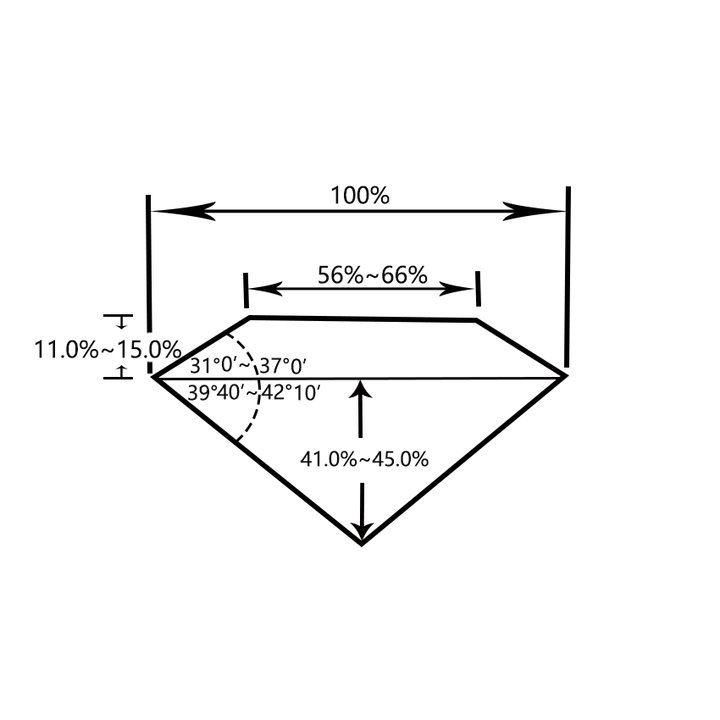
3. International Diamond Council cut The IDC Cut is designed and launched by the International Diamond Council. The standard proportions are: platform width ratio 56%~66%, crown height ratio 11.0%~15.0%, crown angle 31°0'~37°0', pavilion depth ratio 41.0%~45.0%, pavilion angle 39°40' ~37°0'.
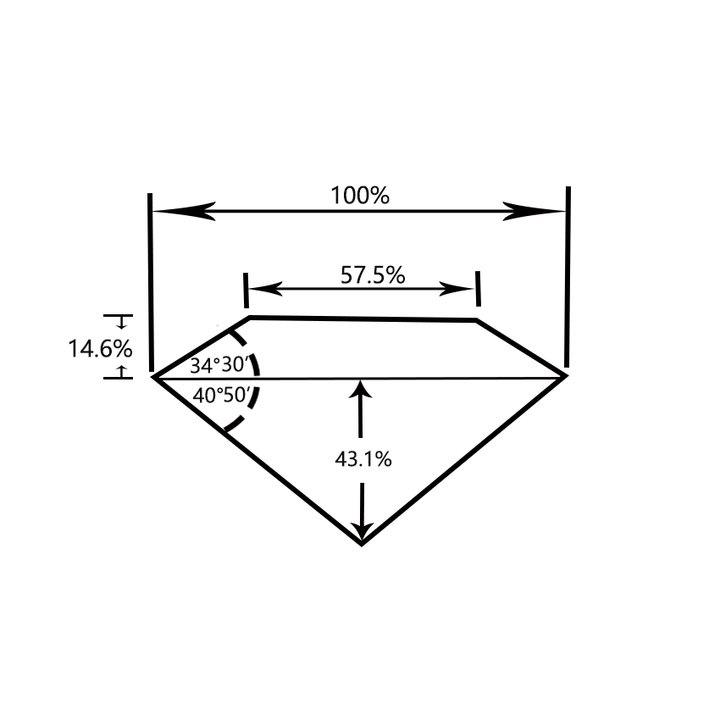
4. Scandinavian cut Scandinavian cut (ScanD.N.Cut), in 1970, was designed and launched by the Scandinavian Diamond Council. Its standard proportions are: platform width ratio 57.5%, crown height ratio 14.6%, crown angle 34°30’, matter depth ratio 43.1%, pavilion angle 40°50’.
Due to the inconsistency of the standards of the above-mentioned cut shapes, among the different diamond grading systems in the world, the differences in the cut evaluation are the most. In the grading standards of IDC and HRD cut ratio, the grade evaluation rules of very good, good, general (or medium), and poor are proposed.
GIA proposes 1, 2, 3, and 4 grade evaluation rules according to the cut ratio and modification;
Measurement items Grade | 1 | 2 | 3 | 4 |
Table Size/% | 53-60 | 61-64 | 65-75/51-52 | >70/<50 |
Crown angle/(°) | 34-35 | 32-34 | 30-32/37 | >37/<30 |
Girdle Thickness | medium - slightly thick | thin or thick | very thin or very thick | extremelythin or extremely thick |
Pavilion Depth/% | 43 | 42/44 | 41/45-46 | >46/<41 |
Culet Size | None - Medium | slightly bigger | big | Very big |
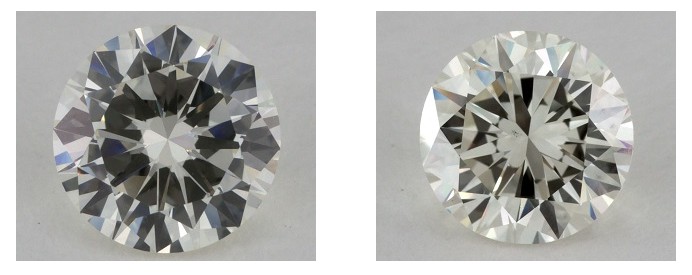
CIBJO does not have a similar grading regulation, and tends to describe the proportions and finishes of diamonds, but does not evaluate them. Although there is no consensus on the optimal proportions of round diamonds, there is consensus on poor ratios. For example, the "fish-eye stone" with a shallow pavilion and the "black bottom stone" with a deep pavilion are both typical examples of poor proportions. Because the brilliance of this type of cut diamond is greatly affected, it should be noted in the remarks when evaluating the diamond.









-

CVD Single-Crystal Diamonds: An Analysis of the Complete Processing Workflow from Gas-Phase Deposition to Finished Diamond Chips
MPCVD (Microwave Plasma Chemical Vapor Deposition) technology is currently the core process for producing high-quality single-crystal diamond s. Thanks to its advantages of low defect rates, high purity, and controllable large dimensions, it is widely used in fields such as semiconductor heat dissipation, precision optics, and high-end sensors. The final quality of single-crystal diamond s depends on comprehensive process control throughout the entire workflow—from vapor deposition growth to pos
-
Single-Crystal or Polycrystalline Diamond — Which Has Greater Potential?
As diamond continues to enter industries such as semiconductors, thermal management, optics, high-power electronics, and precision machining, the requirements for diamond materials are also evolving.
-
Diamond Polishing and Grinding Processes: Core Challenges and Industry Hurdles
Diamond is often hailed as the “ultimate material” – ranking 10 on the Mohs hardness scale, boasting an ultra‑high thermal conductivity (~2,200 W/(m·K)), excellent chemical stability, and broad optical transparency. These properties make it irreplaceable in cutting‑edge applications such as semiconductor heat dissipation, high‑end optics, and quantum chips. Yet the paradox of “good materials are hard to process” is nowhere more evident than in diamond. From rough grinding for planarization to at
-
Single-Crystal vs Polycrystalline CVD Diamond: Process Difference Lies in Growth Logic, Not Equipment
The process difference between single crystal and polycrystalline CVD diamond lies not in equipment, but in growth logic. Single crystal and polycrystalline CVD diamond are two functional new materials with completely independent growth mechanisms, lattice structures and performance systems. Their process logic, product features and application boundaries diverge fundamentally from the very start of deposition and growth. Comparing or selecting materials without considering their underlying crys