- 中文
- English
- Español
Nature sub-journal of the City University of Hong Kong academician team: Composite phase diamond reaches its limit!
2024-05-15 10:06:52
Click:
“
Temperature is one of the seven fundamental physical quantities. The ability to measure temperatures close to absolute zero has driven numerous advances in cryogenic and quantum physics. Currently, temperatures at millikelvin and below are measured through characterization of a system's specific thermal state because no conventional thermometer is capable of measuring temperatures at such low levels.
”
The team of Academician Lu Jian of City University of Hong Kong has developed diamond containing sp2-sp3 composite phase. This diamond-synthesized CPD exhibits a negative temperature coefficient, excellent fit in a wide temperature range, and reaches the 1mK temperature measurement limit. CPD has low magnetic field sensitivity and high thermal stability, and can be made into probes with a diameter of 1 micron, making it an ideal choice for the next generation of low-temperature sensors. This achievement is of great significance to low-temperature physics research and helps quantum computing, simulation and other technologies transform from research to application, and was published in "Nature Communications".
Structural characterization of CPD
CPD essentially originates from the graphitization transformation of diamond. The synthesized CPD has a unique structure and is completely different from traditional graphitized diamond. As shown in Figure 1a, the HRTEM image clearly shows island-like amorphous carbon and graphite fragments evenly embedded in the diamond matrix. These amorphous carbon and graphite fragments together constitute the sp² hybridized carbon phase, while the diamond matrix exhibits an atomic spacing of 0.206 nanometers. This composite phase structure was verified by a variety of characterization methods. In particular, the average size of the amorphous carbon region is 3.55 nanometers (volume fraction 26%), and its atomic spacing is approximately 0.338–0.357 nanometers; while the size of the graphite fragment region is 3.01 nanometers (volume fraction 17%), and its atomic spacing is 0.338 nanometers.

The transformation process of diamond to graphite is quite controversial. It first directly transforms into a rectangular {0002} graphite face along the [_112] crystal axis direction, and then transforms into a fingerprint-like structure toward the<1010>crystal axis (Figure 1b). The entire transformation can be simplified It is d{111}→g{0002}. This transformation process is similar to the transformation of graphite into diamond. Low-magnification HRTEM images show that the nanocomposite phase structure exhibits a repeatable discontinuous periodic distribution in an area of at least 2 microns. The phase transformation process also produces uniform alternating tension and compressive stress fields. These structures and stress fields may be the key to enhancing diamond's high-temperature oxidation resistance.
Conductivity and temperature coefficient of CPD
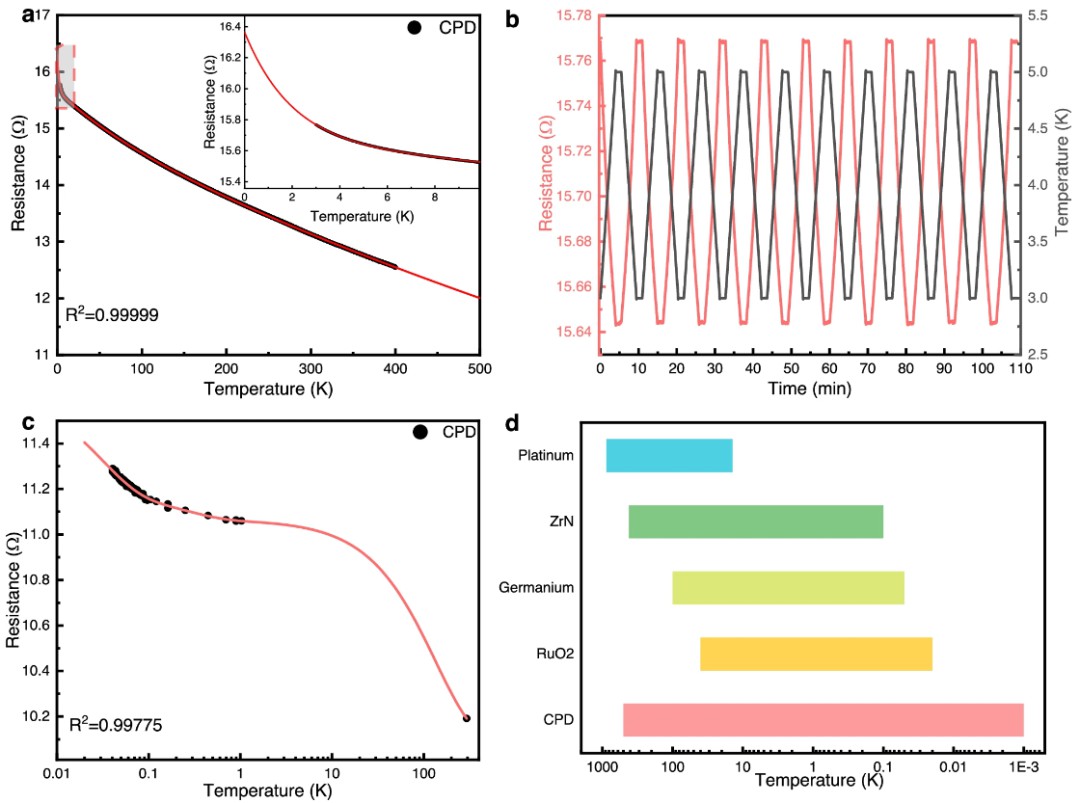
As the temperature decreases from 400 K to 10 K, the resistance of the synthesized CPD increases almost linearly and rises significantly below 10 K. CPD has stable performance close to absolute zero, and its theoretical calibration accuracy is up to 8 mK in the range of 3 to 400 K, with residual errors mainly within ±0.008 arb. In particular, at low temperatures of<10 K, CPD achieves a temperature measurement resolution of 1 mK, which far exceeds the level of existing cryogenic sensors. For example, the resistance of CPD at 2 mK and 1 mK is 16.36614 Ω and 16.36652 Ω respectively, a difference that significantly exceeds the resistance change in adjacent temperature intervals. In addition, researchers have successfully synthesized CPDs at multiple scales, including micron-scale probes (Ø=1 µm), millimeter-scale bulk CPDs, and 3D printed complex structures. These different scales of CPD expand its application scope and significantly enhance its potential value.
CPD magnetoresistance
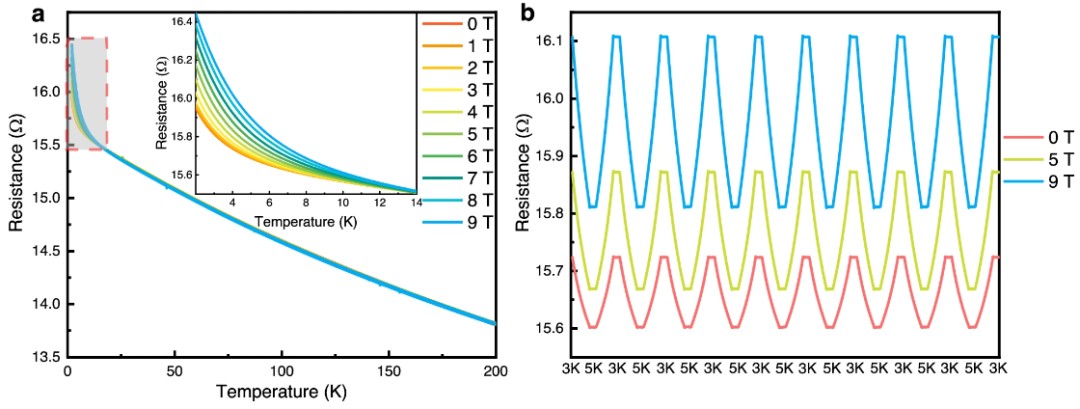
Cryogenic measurements are greatly limited by the presence of magnetic fields. At temperatures >14 K, the CPD is almost insensitive to magnetic field changes (Fig. 3a). Even at<14 K, the change in magnetoresistance of the CPD remains relatively small. At a temperature of 2 K and a strong magnetic field of 9 T, the resistance change rate of CPD is only ~3%. The insensitivity of CPD to magnetic fields is of great significance in applications such as nuclear magnetic resonance.
Summarize
The researchers successfully synthesized CPDs with excellent electrical properties and thermal stability through a simple method. CPD demonstrated its performance and stability as a temperature sensing material in extreme environments. The lowest temperature measurement limit of CPD reaches 1 mK, which can contribute to the advancement of low-temperature physics and quantum physics. In addition, the composite phase structure also has a great impact on diamond properties. This nanoscale crystal reconstruction transforms diamond from a superhard material into a functional material. The successful synthesis of CPD will open up new avenues for the application of diamond in precision measurement, quantum computing, medical equipment and space technology.
As an outstanding enterprise in the industry, High Light Intelligence Technology will continue to be committed to technological innovation and product research and development, and provide customers with better products and services. We look forward to working with more partners to jointly promote the development of new materials and contribute to the scientific and technological progress of mankind.









-

CVD Single-Crystal Diamonds: An Analysis of the Complete Processing Workflow from Gas-Phase Deposition to Finished Diamond Chips
MPCVD (Microwave Plasma Chemical Vapor Deposition) technology is currently the core process for producing high-quality single-crystal diamond s. Thanks to its advantages of low defect rates, high purity, and controllable large dimensions, it is widely used in fields such as semiconductor heat dissipation, precision optics, and high-end sensors. The final quality of single-crystal diamond s depends on comprehensive process control throughout the entire workflow—from vapor deposition growth to pos
-
Single-Crystal or Polycrystalline Diamond — Which Has Greater Potential?
As diamond continues to enter industries such as semiconductors, thermal management, optics, high-power electronics, and precision machining, the requirements for diamond materials are also evolving.
-
Diamond Polishing and Grinding Processes: Core Challenges and Industry Hurdles
Diamond is often hailed as the “ultimate material” – ranking 10 on the Mohs hardness scale, boasting an ultra‑high thermal conductivity (~2,200 W/(m·K)), excellent chemical stability, and broad optical transparency. These properties make it irreplaceable in cutting‑edge applications such as semiconductor heat dissipation, high‑end optics, and quantum chips. Yet the paradox of “good materials are hard to process” is nowhere more evident than in diamond. From rough grinding for planarization to at
-
Single-Crystal vs Polycrystalline CVD Diamond: Process Difference Lies in Growth Logic, Not Equipment
The process difference between single crystal and polycrystalline CVD diamond lies not in equipment, but in growth logic. Single crystal and polycrystalline CVD diamond are two functional new materials with completely independent growth mechanisms, lattice structures and performance systems. Their process logic, product features and application boundaries diverge fundamentally from the very start of deposition and growth. Comparing or selecting materials without considering their underlying crys