- 中文
- English
- Español
Diamond-based transistors, a milestone breakthrough!
2025-02-14 15:42:34
Click:
“
Recently, David Moran, Professor at the James Watt School of Engineering at the University of Glasgow, led a research team in collaboration with the Royal Melbourne Institute of Technology in Australia and Princeton University in the United States to complete a study. Their research results, 'Extreme Enhancement-Mode Operation Accumulation Channel Hydrogen-Terminated Diamond FETs with Vth <−6V and High on-Current', were published in the journal Advanced Electronic Materials.
”
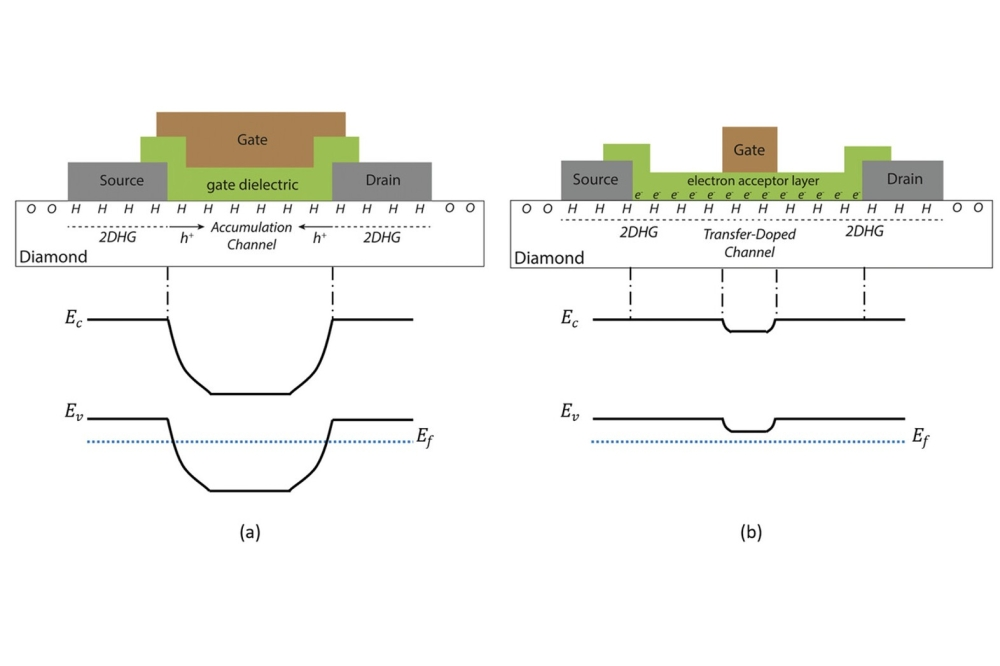
Diamond has an inherently wide bandgap that enables it to handle much higher voltages than silicon before electrical breakdown, making it particularly attractive for high-power electronic applications such as power grids or electric vehicles.
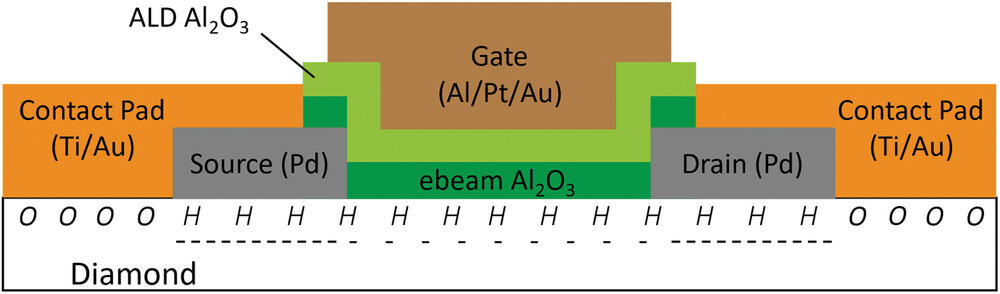
'The challenge in power electronics is that a switch needs to be designed to stay firmly closed when not in use to ensure it meets safety standards, but it also has to deliver very high power when turned on,' Moran said. 'Previous state-of-the-art diamond transistors have typically been good at one at the expense of the other - the switches were good at staying closed but not so good at delivering current on demand, or vice versa. What we've been able to do is design a diamond transistor that excels at both, which is a significant advance.'
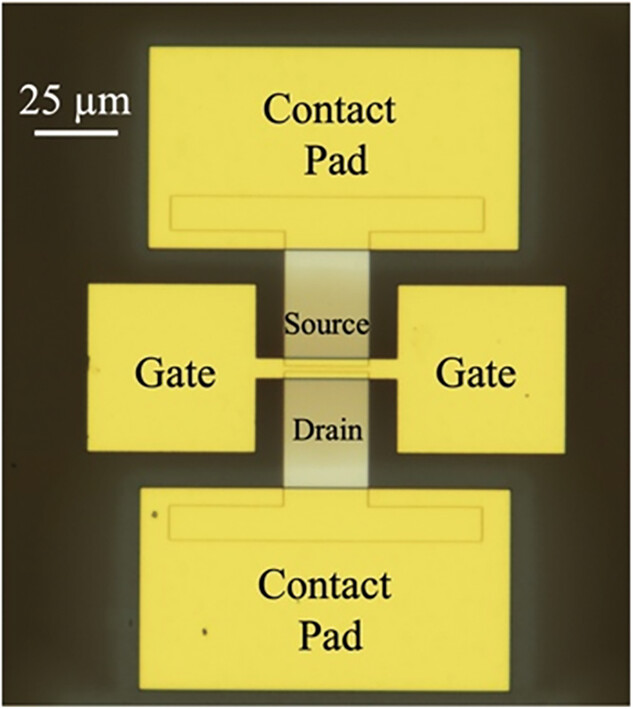
The Watt Nano Center team at the University of Glasgow used surface chemistry to improve the performance of diamond, coating it with hydrogen and then with aluminum oxide. The new diamond transistor requires 6 volts to turn on, has high current, and doubles the efficiency. When it is turned off, the resistance is extremely high, the noise is below the background, and there is almost no current leakage, which is crucial for high-power applications.










-

Foshan Highlight Intelligent Technology invites you to the 140th Canton Fair—join us at Booth 21.2A23-24 in the Friendship Hall to share in the brilliance.
Foshan Highlight Intelligent Technology invites you to the 140th Canton Fair—join us at Booth 21.2A23-24 in the Friendship Hall to share in the brilliance.
-
CVD Single-Crystal Diamonds: An Analysis of the Complete Processing Workflow from Gas-Phase Deposition to Finished Diamond Chips
MPCVD (Microwave Plasma Chemical Vapor Deposition) technology is currently the core process for producing high-quality single-crystal diamond s. Thanks to its advantages of low defect rates, high purity, and controllable large dimensions, it is widely used in fields such as semiconductor heat dissipation, precision optics, and high-end sensors. The final quality of single-crystal diamond s depends on comprehensive process control throughout the entire workflow—from vapor deposition growth to pos
-
Single-Crystal or Polycrystalline Diamond — Which Has Greater Potential?
As diamond continues to enter industries such as semiconductors, thermal management, optics, high-power electronics, and precision machining, the requirements for diamond materials are also evolving.
-
Diamond Polishing and Grinding Processes: Core Challenges and Industry Hurdles
Diamond is often hailed as the “ultimate material” – ranking 10 on the Mohs hardness scale, boasting an ultra‑high thermal conductivity (~2,200 W/(m·K)), excellent chemical stability, and broad optical transparency. These properties make it irreplaceable in cutting‑edge applications such as semiconductor heat dissipation, high‑end optics, and quantum chips. Yet the paradox of “good materials are hard to process” is nowhere more evident than in diamond. From rough grinding for planarization to at