- 中文
- English
- Español
Why do other people's 1-carat diamonds look bigger than each other's?
2026-01-07 14:55:00
Click:
“
Have you ever had this confusion when buying diamonds?
You and your friend both bought 1.5-carat diamonds, but hers looks more impressive on hers; even with the same 1-carat diamond ring specifications, some seem to look more substantial when you try them on—did the seller switch the specifications? Or is it just your perception?
”
Have you ever had this confusion when buying diamonds?
You and your friend both bought 1.5-carat diamonds, but hers looks more impressive on hers; even with the same 1-carat diamond ring specifications, some seem to look more substantial when you try them on—did the seller switch the specifications? Or is it just your perception?
The answer is actually quite simple: the perceived size of a diamond over 1 carat is never solely determined by its carat weight (carats per point)! Today, we'll focus on choosing large diamonds, uncovering the core reasons for the visual size differences between diamonds of the same weight, helping you select your ideal diamond that is both large and dazzling.
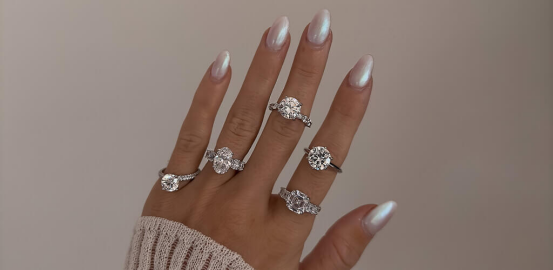
Core Reason: Cutting Technology is the 'Secret to Success'
Many people fall into the misconception that 'weight equals size' when choosing a large diamond, but in reality, a diamond's weight and its visual size are two different things! Just like a cake of the same weight, a thicker cut results in a smaller diameter, while a thinner cut results in a larger diameter—for a 1-carat+ diamond, the cutting technique not only determines whether it appears large, but also directly affects its brilliance and fire, making it a core factor in the selection process.
Diamond cutting involves three key dimensions: diameter, depth, and table size. Different cutting proportions result in vastly different visual effects.
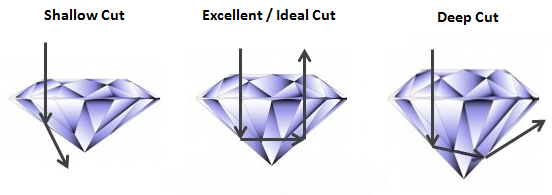
1. Deep Cut Diamonds: Concealing weight in height, appearing smaller but potentially more concentrated fire.
Some 1-carat+ diamonds, to retain more of their original weight (large diamonds are expensive, and weight directly affects the total price), are deep-cut. This concentrates the weight in the diamond's height, naturally reducing the diameter. For example, a 1.0-carat (100 points) round brilliant cut diamond with a deep cut might only have a diameter of 6.3mm, smaller than the standard size, but the light reflection is more concentrated, resulting in a richer fire.
2. Shallow Cut Diamonds:Enlarging the surface, appearing larger but prone to losing fire.
Shallow-cut 1-carat+ diamonds intentionally enlarge the diameter (the visible surface area), concentrating the weight on the surface, making them appear larger. For example, a 1.0-carat round brilliant cut diamond with a shallow cut might have a diameter of 6.7mm, larger than the standard size. However, insufficient cutting depth prevents sufficient light refraction, weakening the fire and even causing a 'grayish' appearance, thus wasting the diamond's brilliance potential.
Ideal Cut/Excellent Cut Diamonds: Balancing Size and Brilliance, the Top Choice for Large Diamonds. An ideal cut (EX grade) precisely controls the diameter, depth, and table ratio of a 1-carat+ diamond, ensuring a large, impressive diameter while allowing light to refract fully within the diamond, maximizing its brilliance. For example, a 1.0-carat EX grade round brilliant cut diamond, with a standard diameter of approximately 6.5mm, is visually striking and transparent, making it the optimal choice for large diamonds—after all, the core value of a large diamond lies in its brilliance and visual presentation.
Besides segmentation, these two factors also affect 'visual size'.
Beyond the core cutting technique, the shape and setting of a 1-carat+ diamond have a more significant impact on its visual size—choosing the right setting can make a large diamond appear even larger and enhance its overall look!
1. Diamond Shape: 'Elongated' Shapes Appear Larger
Different diamond shapes create completely different visual extensions:
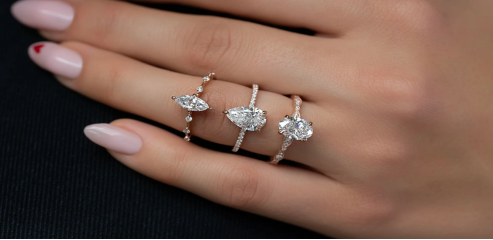
The Kings of Size: Oval Cut, Pear Cut, and Marquise Cut. These 'elongated' diamonds, for the same weight, are longer, vertically extending the lines of the fingers and creating a much more imposing visual presence than round diamonds. For example, a 1.2-carat oval diamond has a visual effect comparable to a 1.5-carat round cut diamond, especially suitable for those with slender fingers, making their hands appear slimmer and more elegant.
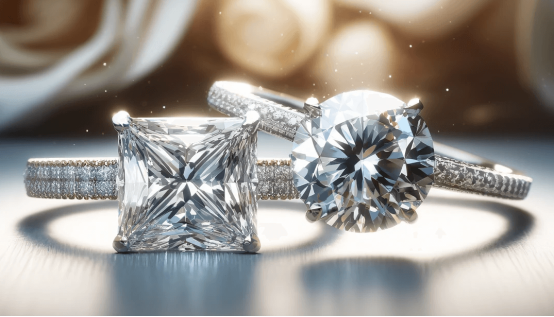
Classic and reliable: Round Cut, Square Cut (Princess Cut, Cushion Cut). Round diamonds are the most classic 'value-preserving' option, symmetrical and stable but without a sense of extension, and their visual size is moderate; square diamonds have sharp edges and a powerful presence. The visual width of a 1.2-carat square diamond is similar to that of a 1.3-carat round diamond, making it suitable for those who prefer a simple and elegant style.
2. Setting Method: 'More Exposed' Makes it Appear Larger
The setting method for a 1-carat diamond not only affects its perceived size but also its security! The more exposed the diamond, the larger it appears, but a large diamond needs a secure hold. We recommend balancing 'larger appearance' and 'security':
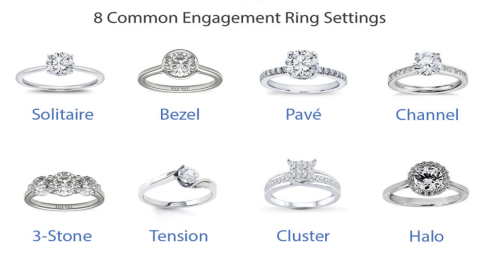
Prioritize: Prong Setting, Floating Setting. Four-prong/six-prong settings use a few metal prongs to secure the large diamond, maximizing the exposure of the diamond's surface and highlighting its clarity and size. Floating settings, without a metal base, fully showcase the diamond's outline and height from the side, creating a more three-dimensional and grand visual effect. Pairing it with a 'Halo Setting' of clustered diamonds (just for embellishment) can further amplify the visual effect of the large diamond.
Safety First: Bezel Setting and Channel Setting. Bezel setting uses metal to enclose the edge of a large diamond, providing extremely high security and making it suitable for everyday wear. However, the large area covered can make a large diamond appear smaller than it actually is. Channel setting is suitable for styles with multiple small and large diamonds arranged together. It is very secure, but the effect of making a single large diamond appear larger is generally not as good.
'KF deer' offers a wide variety of diamond ring styles to suit different occasions, as well as customization services. If you would like to learn more about lab-grown diamond styles and prices, or need professional diamond purchasing advice—for example, have you ever encountered the situation where a diamond over 1 carat appears smaller than its weight? Or do you have other questions about purchasing large diamonds? Feel free to message us. We will be sharing more information about lab-grown diamonds and popular products in the future!
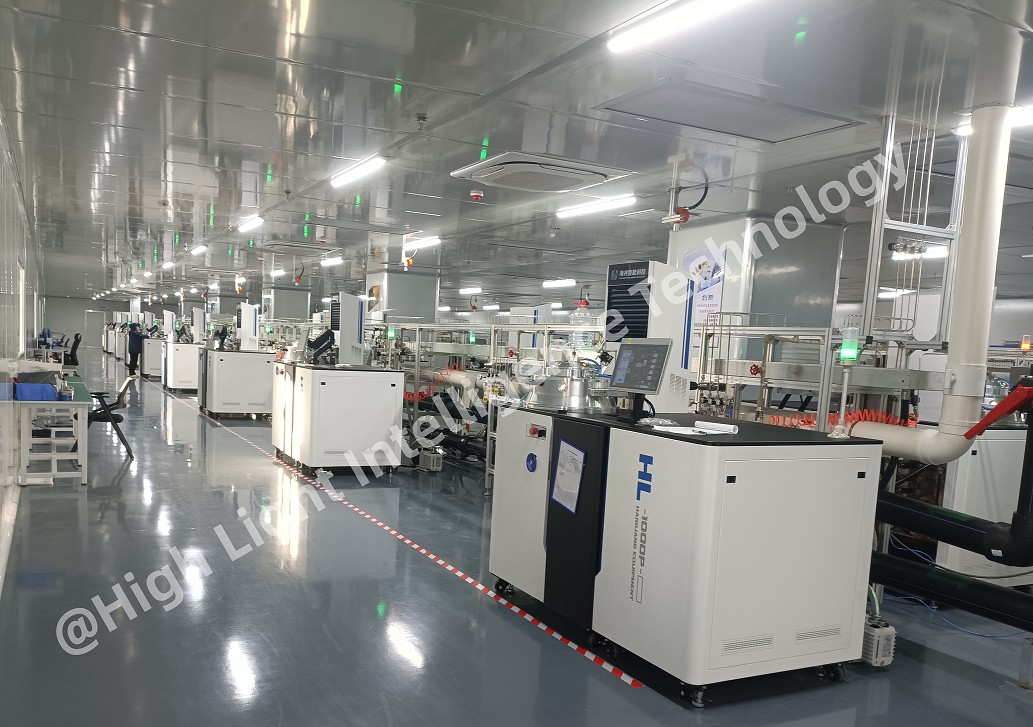
High Light Intelligence Technology, a pioneer in the CVD diamond industry, has advanced MPCVD technology and CVD diamond production workshops. We focus on producing high-purity lab-grown diamonds for the jewelry industry, and at the same time create industrial-grade CVD diamond products, covering single crystals, polycrystalline, films and diamond surface metallization. We also provide 6kw/10kw/15kw MPCVD equipment to help customers in all aspects, from equipment to products, and then to all-round services, to create brilliance together.
*The articles and pictures are only for industry communication and sharing. If there is any infringement, please contact us to delete them.









-

CVD Single-Crystal Diamonds: An Analysis of the Complete Processing Workflow from Gas-Phase Deposition to Finished Diamond Chips
MPCVD (Microwave Plasma Chemical Vapor Deposition) technology is currently the core process for producing high-quality single-crystal diamond s. Thanks to its advantages of low defect rates, high purity, and controllable large dimensions, it is widely used in fields such as semiconductor heat dissipation, precision optics, and high-end sensors. The final quality of single-crystal diamond s depends on comprehensive process control throughout the entire workflow—from vapor deposition growth to pos
-
Single-Crystal or Polycrystalline Diamond — Which Has Greater Potential?
As diamond continues to enter industries such as semiconductors, thermal management, optics, high-power electronics, and precision machining, the requirements for diamond materials are also evolving.
-
Diamond Polishing and Grinding Processes: Core Challenges and Industry Hurdles
Diamond is often hailed as the “ultimate material” – ranking 10 on the Mohs hardness scale, boasting an ultra‑high thermal conductivity (~2,200 W/(m·K)), excellent chemical stability, and broad optical transparency. These properties make it irreplaceable in cutting‑edge applications such as semiconductor heat dissipation, high‑end optics, and quantum chips. Yet the paradox of “good materials are hard to process” is nowhere more evident than in diamond. From rough grinding for planarization to at
-
Single-Crystal vs Polycrystalline CVD Diamond: Process Difference Lies in Growth Logic, Not Equipment
The process difference between single crystal and polycrystalline CVD diamond lies not in equipment, but in growth logic. Single crystal and polycrystalline CVD diamond are two functional new materials with completely independent growth mechanisms, lattice structures and performance systems. Their process logic, product features and application boundaries diverge fundamentally from the very start of deposition and growth. Comparing or selecting materials without considering their underlying crys