- 中文
- English
- Español
Diamond Ring Setting Guide: Choose the right setting to make your diamond appear 20% larger and protect it for a lifetime!
2026-01-08 14:58:43
Click:
“
When choosing a diamond ring of 1 carat or larger, many consumers focus on comparing the 4Cs (cut, color, clarity, and carat weight) but overlook the importance of the setting.
In fact, the setting not only directly affects the visual appeal of the diamond ring but also plays a crucial role in its safety. For example, a 1.5-carat round brilliant diamond of the same quality can fully showcase its brilliance with a prong setting, while a bezel setting effectively enhances its security. If the sett
”
When choosing a diamond ring of 1 carat or larger, many consumers focus on comparing the 4Cs (cut, color, clarity, and carat weight) but overlook the importance of the setting.
In fact, the setting not only directly affects the visual appeal of the diamond ring but also plays a crucial role in its safety. For example, a 1.5-carat round brilliant diamond of the same quality can fully showcase its brilliance with a prong setting, while a bezel setting effectively enhances its security. If the setting is chosen inappropriately, even a 2-carat diamond may suffer from poor visual appeal and be more susceptible to damage.
This article will systematically outline five mainstream setting methods suitable for large diamonds, analyzing in detail the advantages and disadvantages of each method and their appropriate application scenarios. It aims to provide consumers with professional purchasing guidance, helping them avoid common pitfalls and select an ideal diamond ring that combines visual appeal with durability.
Core Design: The diamond's girdle is secured with 3-6 metal prongs, maximizing the exposure of the crown and pavilion to ensure unobstructed 360°light penetration and maximize the diamond's brilliance.
Main Styles:
Four-Prong Setting: A simple and elegant design with minimal metal prongs, suitable for 1-1.5 carat round or princess-cut diamonds, highlighting the diamond's clarity.
Six-Prong Setting: The classic Tiffany setting, offering superior stability and is the preferred choice for diamonds 1.5 carats and above, combining classic style with value retention.
Main Advantages and Disadvantages:
Advantages: Excellent diamond-enhancing effect, fully showing the brilliance of large diamonds; versatile style, suitable for various diamond shapes.
Disadvantages: Metal prongs can easily snag on clothing or hair; requires regular in-store checks to ensure prongs are secure and prevent the diamond from shifting.
Suitable Occasions: Suitable for engagement rings, formal occasions such as banquets; not suitable for everyday household chores or sports activities.

Core Design: A metal frame completely surrounds the diamond, with a smooth, polished surface providing all-around protection.
Exclusive Advantages: Excellent fit for fancy-shaped diamonds such as pear cut, marquise cut, and heart cut, effectively protecting sharp edges and reducing the risk of breakage from impacts.
Main Advantages and Disadvantages:
Advantages: High level of protection and security, suitable for frequent daily wear; smooth, edge-free frame, less prone to snagging.
Disadvantages: The metal frame may partially obscure the diamond's edges, slightly diminishing its visual impact compared to prong settings; requires a higher level of setting skill; a thicker frame can make the diamond appear bulky.
Suitable Scenarios: Suitable for frequent wear scenarios such as daily commutes; ideal for professionals and those with high activity levels who prioritize understated durability.
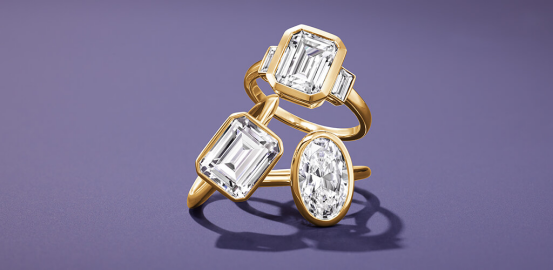
Core Design: A halo setting surrounds a 1-carat or larger main diamond, creating a 'halo' effect that effectively enlarges the visual size of the main diamond.
Visual Effect: A 1.2-carat main diamond with a halo setting can achieve the visual presence of a 1.5-carat diamond; if the main diamond is prong-set, a layered fire effect can be achieved, further enhancing its brilliance.
Main Advantages and Disadvantages:
Advantages: Can increase the visual size of the main diamond by 20%-30%, offering excellent value for money; the style is gorgeous and romantic, widely favored by young consumers both domestically and internationally.
Disadvantages: The stability of the side stones needs to be checked regularly; dirt can easily accumulate in the setting gaps, making cleaning and maintenance slightly more difficult.
Suitable Occasions: Engagement rings, anniversary gifts; suitable for consumers who prefer a glamorous style and want to achieve the visual effect of a large diamond at a relatively economical cost.

Core Design: Two or more diamonds, each 1 carat or larger, are set parallel to each other within metal channels. The diamonds are secured without prongs, resulting in a smooth, even surface with prominent lines.
Design Features: Suitable for creating pavé diamond rings, bracelets, and other jewelry. The parallel setting of multiple large diamonds creates a strong visual impact, representing a signature design of understated luxury.
Main Advantages and Disadvantages:
Advantages: Strong overall aesthetic; simple and sophisticated design; high diamond stability, less prone to falling out.
Disadvantages: The metal channels may partially obscure the sides of the diamonds, slightly diminishing their brilliance; not suitable for setting a single large diamond.
Suitable Scenarios: Custom-made multi-diamond jewelry; everyday understated luxury; suitable for fashion-conscious consumers who appreciate personalized design.

Core Design: The main diamond is suspended and fixed above the ring setting via a concealed structure, with no metal obstructing the bottom. Light can penetrate directly from the bottom, showcasing the diamond's transparency and brilliance from all angles, creating a 'floating on your fingertip' visual effect.
Style Characteristics: Minimalist and avant-garde design with a strong artistic feel, ideal for pairing with large fancy-shaped diamonds such as oval cut and pear cut.
Main Advantages and Disadvantages:
Advantages: Excellent diamond brilliance, highlighting a high-end feel; unique design, highly recognizable.
Disadvantages: Relatively weaker fixing stability, not suitable for everyday vigorous activities; requires extremely high-level setting craftsmanship, resulting in higher costs.
Suitable Occasions: High-end formal occasions such as evening banquets and red carpets; suitable for enthusiasts of 1.5 carats and above fancy-shaped diamonds who appreciate unique designs.

For diamonds of 1 carat or larger, an 18K gold setting is recommended. 18K gold is harder than platinum, providing a more secure hold and reducing the risk of deformation. For prong settings, choose rings with rounded prongs to prevent snagging on clothing; it's also advisable to have the prongs checked annually to ensure they are secure and prevent the diamond from loosening or falling out.
Cleaning and Maintenance Recommendations: For prong and halo settings, use a soft-bristled brush with warm water to clean the crevices; for bezel settings, simply polish with a jewelry-specific cleaning cloth.
'KF deer' offers a wide variety of diamond ring styles to suit different occasions, as well as customization services. If you would like to learn more about lab-grown diamond styles and prices, or need professional diamond purchasing advice, such as if your 1-carat or larger diamond ring uses one of the above-mentioned setting methods, or if you are struggling to choose the setting method for a 1-carat round diamond, feel free to message us. We will continue to push more lab-grown diamond information and popular products for you!

*The articles and pictures are only for industry communication and sharing. If there is any infringement, please contact us to delete them.









-

CVD Single-Crystal Diamonds: An Analysis of the Complete Processing Workflow from Gas-Phase Deposition to Finished Diamond Chips
MPCVD (Microwave Plasma Chemical Vapor Deposition) technology is currently the core process for producing high-quality single-crystal diamond s. Thanks to its advantages of low defect rates, high purity, and controllable large dimensions, it is widely used in fields such as semiconductor heat dissipation, precision optics, and high-end sensors. The final quality of single-crystal diamond s depends on comprehensive process control throughout the entire workflow—from vapor deposition growth to pos
-
Single-Crystal or Polycrystalline Diamond — Which Has Greater Potential?
As diamond continues to enter industries such as semiconductors, thermal management, optics, high-power electronics, and precision machining, the requirements for diamond materials are also evolving.
-
Diamond Polishing and Grinding Processes: Core Challenges and Industry Hurdles
Diamond is often hailed as the “ultimate material” – ranking 10 on the Mohs hardness scale, boasting an ultra‑high thermal conductivity (~2,200 W/(m·K)), excellent chemical stability, and broad optical transparency. These properties make it irreplaceable in cutting‑edge applications such as semiconductor heat dissipation, high‑end optics, and quantum chips. Yet the paradox of “good materials are hard to process” is nowhere more evident than in diamond. From rough grinding for planarization to at
-
Single-Crystal vs Polycrystalline CVD Diamond: Process Difference Lies in Growth Logic, Not Equipment
The process difference between single crystal and polycrystalline CVD diamond lies not in equipment, but in growth logic. Single crystal and polycrystalline CVD diamond are two functional new materials with completely independent growth mechanisms, lattice structures and performance systems. Their process logic, product features and application boundaries diverge fundamentally from the very start of deposition and growth. Comparing or selecting materials without considering their underlying crys