- 中文
- English
- Español
Nanodiamond, a major breakthrough!
2025-01-10 10:04:43
Click:
“
In recent decades, the combination of quantum technology and nanomaterials has brought about great changes in science and technology, especially the emergence of fluorescent nanodiamonds (FNDs), which have shown great potential in quantum sensing and biomedicine. FNDs play an important role in biological detection, quantum computing and extreme environment sensing due to their excellent physical stability and optical properties.
”
Key properties of fluorescent nanodiamonds
The leap from micrometers to nanometers
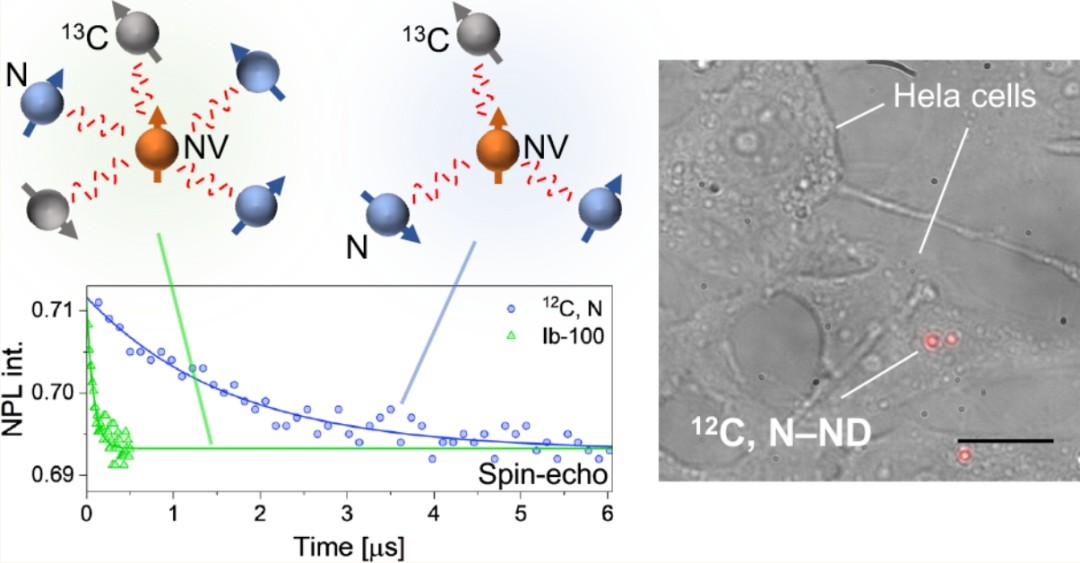
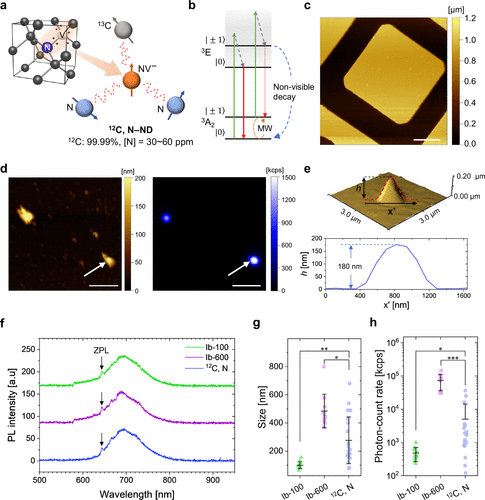
Improving the brightness and quantum performance of fluorescent nanodiamonds is an application obstacle. Researchers at the University of Florida used high pressure and high temperature methods and electron beam irradiation technology to synthesize 50-700 nanometer high-purity nanodiamonds with a nitrogen-vacancy concentration of 0.6-1.3ppm and 99.99% 12C to reduce impurity interference. After the improvement, the brightness was significantly improved, the contrast of the magnetic resonance signal only required 1/20 of the traditional microwave power, and the spin relaxation time was extended by 5-11 times, approaching the performance of bulk diamonds, laying the foundation for high-sensitivity biological detection.
Applications in biomedicine
Fluorescent nanodiamonds are used in biomedicine for high-resolution imaging and biosensing. They can be functionalized as biomarker molecules to track cell structures, and use NV centers to monitor changes in the cell microenvironment, such as achieving real-time intracellular temperature measurement (quantum thermal measurement), with sensitivity far exceeding that of traditional sensors. At the same time, they have great potential in drug delivery, can accurately deliver and track drug release, and provide new possibilities for personalized medicine.

Extreme environment sensing and quantum technology
Fluorescent nanodiamonds have outstanding performance in extreme environment sensing, and can withstand high temperature, high pressure and strong radiation, while maintaining quantum performance. In geological exploration, they can measure changes in the earth's crust magnetic field and help predict earthquakes and other activities. They also have great potential in the field of quantum computing. The NV center quantum spin can store operational information and is expected to become the core of quantum computers. Its quantum bits are superior to others in coherence time and anti-interference, which is of great significance to quantum computing and communications.
Challenges and prospects
Fluorescent nanodiamonds have broad prospects, but they face technical and application challenges, such as high cost, insufficient preparation consistency, and safety and functionalization issues in biomedical applications. With the advancement of quantum material technology, these problems are expected to be solved. In the future, fluorescent nanodiamonds may be used in high-performance batteries, environmental monitoring, optoelectronic devices, etc., and may enter the consumer field due to cost reduction, such as high-end cosmetics and smart wearable devices.
Conclusion
Fluorescent nanodiamond combines quantum and nanotechnology, and leads scientific research and application innovation with its unique optical and quantum properties, covering biomedicine, quantum computing, environmental sensing and personalized medicine. In the future, it will continue to promote the frontier of science and technology and help humans explore the unknown.

High Light Intelligence Technology, a pioneer in the CVD diamond industry, has advanced MPCVD technology and CVD diamond production workshops. We focus on producing high-purity lab-grown diamonds for the jewelry industry, and at the same time create industrial-grade CVD diamond products, covering single crystals, polycrystalline, films and diamond surface metallization. We also provide 6kw/10kw/15kw MPCVD equipment to help customers in all aspects, from equipment to products, and then to all-round services, to create brilliance together.
*The articles and pictures are only for industry communication and sharing. If there is any infringement, please contact us to delete them.









-

Foshan Highlight Intelligent Technology invites you to the 140th Canton Fair—join us at Booth 21.2A23-24 in the Friendship Hall to share in the brilliance.
Foshan Highlight Intelligent Technology invites you to the 140th Canton Fair—join us at Booth 21.2A23-24 in the Friendship Hall to share in the brilliance.
-
CVD Single-Crystal Diamonds: An Analysis of the Complete Processing Workflow from Gas-Phase Deposition to Finished Diamond Chips
MPCVD (Microwave Plasma Chemical Vapor Deposition) technology is currently the core process for producing high-quality single-crystal diamond s. Thanks to its advantages of low defect rates, high purity, and controllable large dimensions, it is widely used in fields such as semiconductor heat dissipation, precision optics, and high-end sensors. The final quality of single-crystal diamond s depends on comprehensive process control throughout the entire workflow—from vapor deposition growth to pos
-
Single-Crystal or Polycrystalline Diamond — Which Has Greater Potential?
As diamond continues to enter industries such as semiconductors, thermal management, optics, high-power electronics, and precision machining, the requirements for diamond materials are also evolving.
-
Diamond Polishing and Grinding Processes: Core Challenges and Industry Hurdles
Diamond is often hailed as the “ultimate material” – ranking 10 on the Mohs hardness scale, boasting an ultra‑high thermal conductivity (~2,200 W/(m·K)), excellent chemical stability, and broad optical transparency. These properties make it irreplaceable in cutting‑edge applications such as semiconductor heat dissipation, high‑end optics, and quantum chips. Yet the paradox of “good materials are hard to process” is nowhere more evident than in diamond. From rough grinding for planarization to at