- 中文
- English
- Español
The Real Challenge Is Not Growing Diamond. It's Scaling It.
2026-09-07 17:22:13
Click:
“
Growing diamond in a laboratory is one thing.
Producing consistent diamond at industrial scale is another.
In the CVD diamond industry, we often talk about the growth rate, thermal conductivity, wafer size,single crystal plate size, MPCVD equipment performance, stable plasma ball, bigger growing substrate space when growing etc.
From my perspective as a project manager in the CVD diamond industry, many customers will ask one question can you ensure the quality consistently?
”
Growing diamond in a laboratory is one thing.Producing consistent diamond at industrial scale is another.
In the CVD diamond industry, we often talk about the growth rate, thermal conductivity, wafer size,single crystal plate size, MPCVD equipment performance, stable plasma ball, bigger growing substrate space when growing etc.
From my perspective as a project manager in the CVD diamond industry, many customers will ask one question can you ensure the quality consistently?
So it reveal a real question is:Can we turn a successful growth process laboratory product into stable, repeatable and commercially viable product?
1. Size
From a small size laboratory sample plate to larger size plate or wafer it is not a simple matter of making the equipment growing base bigger.
As the growth substrate bigger, the plasma ball uniformity, temperature distribution of the growing area, stress control, gas flow become more and more important.
A process that performs well on a small scale may face very different challenges when scaled up to a much larger area.

2. Quality for the right application
For semiconductor thermal management applications, thermal conductivity and surface polished and roughness may be critical.
For optical applications, transparency and absorption characteristics can be key factors.
So the amibition is not simply to make the “best” daimond, it is make the most suitable diamond quality to the application according
3. Consistency
Producing one piece high-quality diamond is not enough.
Industrial diamond scale production need to confirm the quality same as the laboratory one and consistent quality.
Thickness, thermal conductivity, defects and surface characteristics all need to be controlled Predictable and within acceptable tolerance limits
4. Cost and yield
This may the key factor from laboratory product to commercial product in the market.
A material can have outstanding performance, but if the production cycle is too long, yield is too low, or processing costs are too high, large-scale adoption becomes difficult.
For industrial applications:
Performance + Consistency + Yield + Cost = Commercialization
This is why I believe that next stage of CVD diamond development it is not only who can grow the diamond with best performance, it is depend on who can bulk production and make the best performance product commercialized
The future will be decided by who can make that quality repeatable, scalable and commercially viable.
It is challenge but it is also the most interesting opportunities.
What do you think is the biggest bottleneck when advanced materials move from R&D to mass production?

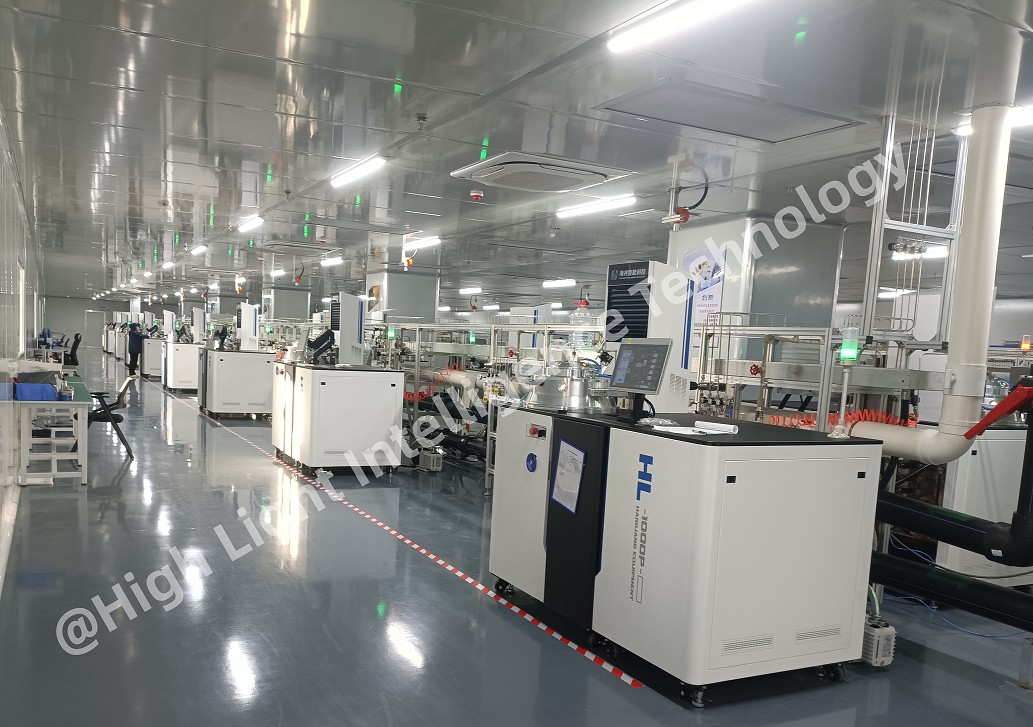
High Light Intelligence Technology, a pioneer in the CVD diamond industry, has advanced MPCVD technology and CVD diamond production workshops. We focus on producing high-purity lab-grown diamonds for the jewelry industry, and at the same time create industrial-grade CVD diamond products, covering single crystals, polycrystalline, films and diamond surface metallization. We also provide 6kw/10kw/15kw MPCVD equipment to help customers in all aspects, from equipment to products, and then to all-round services, to create brilliance together.









-

CVD Single-Crystal Diamonds: An Analysis of the Complete Processing Workflow from Gas-Phase Deposition to Finished Diamond Chips
MPCVD (Microwave Plasma Chemical Vapor Deposition) technology is currently the core process for producing high-quality single-crystal diamond s. Thanks to its advantages of low defect rates, high purity, and controllable large dimensions, it is widely used in fields such as semiconductor heat dissipation, precision optics, and high-end sensors. The final quality of single-crystal diamond s depends on comprehensive process control throughout the entire workflow—from vapor deposition growth to pos
-
Single-Crystal or Polycrystalline Diamond — Which Has Greater Potential?
As diamond continues to enter industries such as semiconductors, thermal management, optics, high-power electronics, and precision machining, the requirements for diamond materials are also evolving.
-
Diamond Polishing and Grinding Processes: Core Challenges and Industry Hurdles
Diamond is often hailed as the “ultimate material” – ranking 10 on the Mohs hardness scale, boasting an ultra‑high thermal conductivity (~2,200 W/(m·K)), excellent chemical stability, and broad optical transparency. These properties make it irreplaceable in cutting‑edge applications such as semiconductor heat dissipation, high‑end optics, and quantum chips. Yet the paradox of “good materials are hard to process” is nowhere more evident than in diamond. From rough grinding for planarization to at
-
Single-Crystal vs Polycrystalline CVD Diamond: Process Difference Lies in Growth Logic, Not Equipment
The process difference between single crystal and polycrystalline CVD diamond lies not in equipment, but in growth logic. Single crystal and polycrystalline CVD diamond are two functional new materials with completely independent growth mechanisms, lattice structures and performance systems. Their process logic, product features and application boundaries diverge fundamentally from the very start of deposition and growth. Comparing or selecting materials without considering their underlying crys