- 中文
- English
- Español
Diamond chips are about to be commercialized
2024-06-07 10:26:15
Click:
“
Diamond has emerged in the semiconductor industry in recent years and has become the focus of the industry. In order to achieve decarbonization, the industry strives for more advanced semiconductor technology. Breakthroughs in materials such as gallium nitride and silicon carbide have helped the industry surpass the limitations of silicon and are widely used in carbon reduction technologies such as renewable energy and electric vehicles. As an emerging semiconductor material, diamond is world-r
”
Diamond has emerged in the semiconductor industry in recent years and has become the focus of the industry. In order to achieve decarbonization, the industry strives for more advanced semiconductor technology. Breakthroughs in materials such as gallium nitride and silicon carbide have helped the industry surpass the limitations of silicon and are widely used in carbon reduction technologies such as renewable energy and electric vehicles. As an emerging semiconductor material, diamond is world-renowned for its hardness and brightness. It was once mainly used in jewelry, but now its characteristics show great potential in the semiconductor field and have attracted much attention.

As a semiconductor material, diamond has three major advantages: excellent thermal management, cost/efficiency optimization, and environmental protection and emission reduction. Its resistivity decreases with increasing temperature, so it performs better at 150°C without the need for a complex cooling system. Diamond has excellent heat dissipation properties, making the converter lightweight, small and efficient. In applications such as electric vehicles, diamond can significantly reduce costs, increase efficiency, and reduce size and weight. Compared to silicon carbide, diamond chips are less expensive, more energy efficient, smaller and have better thermal management. Diamond will play an important role in energy-saving fields such as electric vehicles, and the market potential is huge.


Diamond has extremely high insulation properties, with a breakdown electric field strength of 10 MV/cm, far exceeding that of silicon, SiC and GaN. Its excellent thermal conductivity makes it suitable for heat dissipation of 5G components to ensure stable operation. Diamond substrates combined with gallium nitride or silicon carbide can be used to manufacture high-efficiency power devices, which are widely used in electric vehicles, renewable energy and other fields. As high-quality heat sinks, diamond substrates extend equipment life and improve reliability. With the advancement of clean energy and automotive electrification, diamond substrates will play a key role. The diamond semiconductor substrate market was valued at US$151 million in 2023 and is expected to reach US$342 million by 2030, with the Asia-Pacific region dominating the market.
Although high-performance semiconductor materials are superior, they face limitations such as high cost and small size of diamond wafers. The cost of silicon carbide is 30-40 times that of silicon, gallium nitride is as high as 650-1300 times, and the price of diamond materials is 10,000 times that of silicon. To overcome these limitations, many companies are working on diamond mass production technology. Saga University in Japan and Orbray successfully manufactured 2-inch diamond power semiconductors, and Diamond Foundry in the United States manufactured single-crystal diamond wafers with a diameter of about 4 inches. French Diamfab has also made progress in diamond chip technology. In March this year, it received a first round of financing of 8.7 million euros, supported by investors such as Asterion Ventures and the French government. Diamfab was derived from the Nair Institute of the French National Center for Scientific Research (CNRS) and was founded by two nanoelectronics doctors and researchers.
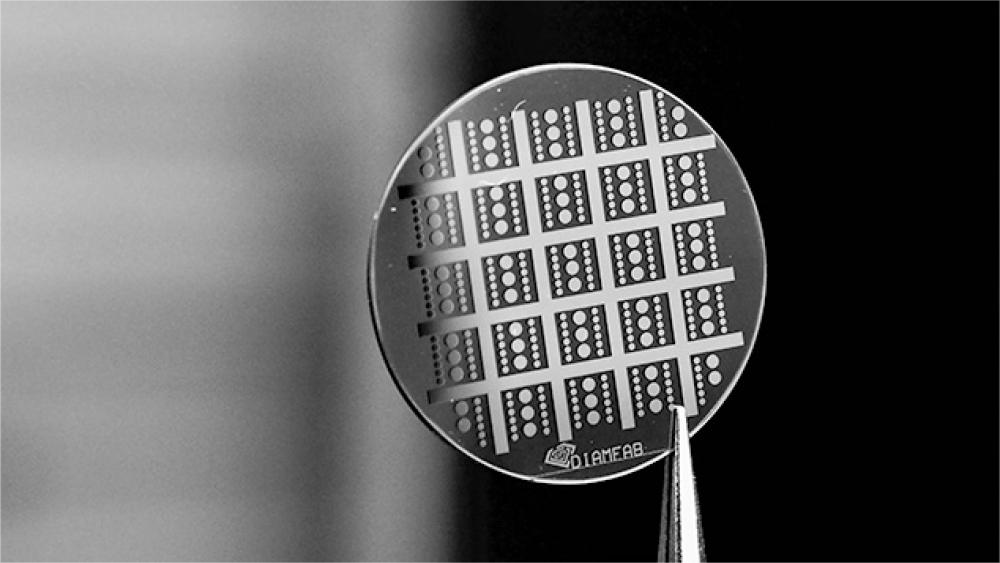
Diamfab has made breakthroughs in diamond epitaxy and doping technology, owns four patents, and focuses on diamond layer growth, doping and electronic component design. The first round of financing will help it establish a pilot production line and accelerate the industrialization of diamond semiconductor technology. Diamfab's diamond technology achieves high current density and breakdown electric field, surpassing existing materials such as SiC, and plans to achieve 4-inch wafer production in 2025. CEO Gauthier Chicot emphasized the importance of cooperation with partners and reducing the carbon footprint of semiconductors. Another startup, Advent Diamond, focuses on mass production of diamond semiconductors. It is the only company that can grow single-crystal phosphorus-doped diamond on a substrate, has achieved the manufacture of n-type semiconductors, and has made progress in growing boron-doped diamond layers over large areas. It has comprehensive component design, manufacturing and characterization capabilities.

Advent Diamond develops diamond radiation detectors, bringing changes to the defense, commercial and scientific markets. The detectors show excellent performance through doping and intrinsic diamond layers, and are suitable for a variety of radiation. Faced with challenges in wafer size and defects, but received institutional funding to promote technological development. Committed to innovation in diamond semiconductor performance, promoting the development of electrification, telecommunications and quantum fields. Akhan Semiconductor uses cryogenic technology to break the limitations of diamond use, successfully creates n-type diamond materials, and develops the Miraj Diamond platform. CMOS silicon is combined with diamond substrates to make 300 mm wafers. This year, a new company Diamond Quanta was established to focus on the semiconductor field. Its "unified diamond frame" technology transforms diamond into high-performance semiconductors, which is expected to redefine performance standards and meet the needs of modern industry.


Despite the high domestic diamond production, it still lags behind in functional applications and material development. Wang Dong, deputy director of the Wuhu Research Institute of Xidian University, pointed out that the domestic diamond industry is large but not strong, and lags behind in high-end fields. In CVD diamond research, the United States, Europe, and Japan are leading, and my country has little original research. Although there are challenges in the mass production and commercial use of diamonds around the world, the excellent properties of diamond materials are expected to promote important progress in the field of semiconductor materials in the future.
*The article is only for industry communication and sharing. If it involves infringement, please contact us to delete it.









-

CVD Single-Crystal Diamonds: An Analysis of the Complete Processing Workflow from Gas-Phase Deposition to Finished Diamond Chips
MPCVD (Microwave Plasma Chemical Vapor Deposition) technology is currently the core process for producing high-quality single-crystal diamond s. Thanks to its advantages of low defect rates, high purity, and controllable large dimensions, it is widely used in fields such as semiconductor heat dissipation, precision optics, and high-end sensors. The final quality of single-crystal diamond s depends on comprehensive process control throughout the entire workflow—from vapor deposition growth to pos
-
Single-Crystal or Polycrystalline Diamond — Which Has Greater Potential?
As diamond continues to enter industries such as semiconductors, thermal management, optics, high-power electronics, and precision machining, the requirements for diamond materials are also evolving.
-
Diamond Polishing and Grinding Processes: Core Challenges and Industry Hurdles
Diamond is often hailed as the “ultimate material” – ranking 10 on the Mohs hardness scale, boasting an ultra‑high thermal conductivity (~2,200 W/(m·K)), excellent chemical stability, and broad optical transparency. These properties make it irreplaceable in cutting‑edge applications such as semiconductor heat dissipation, high‑end optics, and quantum chips. Yet the paradox of “good materials are hard to process” is nowhere more evident than in diamond. From rough grinding for planarization to at
-
Single-Crystal vs Polycrystalline CVD Diamond: Process Difference Lies in Growth Logic, Not Equipment
The process difference between single crystal and polycrystalline CVD diamond lies not in equipment, but in growth logic. Single crystal and polycrystalline CVD diamond are two functional new materials with completely independent growth mechanisms, lattice structures and performance systems. Their process logic, product features and application boundaries diverge fundamentally from the very start of deposition and growth. Comparing or selecting materials without considering their underlying crys