- 中文
- English
- Español
Diamond heat sink boosts heat dissipation in advanced packaging
2024-09-11 09:29:05
Click:
“
Cutting-edge technologies such as AI and cloud computing are making great strides with the help of high-performance chips, and with global and Chinese technology companies jointly promoting development, smart hardware chips will usher in explosive growth.
”
AI, deep learning, cloud computing, supercomputing and other cutting-edge technologies drive technological leaps, with high-performance chips as the common foundation. Global technology giants such as Google, Amazon, Intel, Nvidia, and AMD are deeply engaged in this field; Chinese companies such as Huawei, Alibaba, Baidu, and Tencent are also actively contributing to the AI wave. In the future, intelligent hardware chips such as CPU, GPU, ASIC, and FPGA will usher in explosive growth.

Moore's Law Slows Down

What is 2.5D packaging?
TrendForce reports that the surge in generative AI applications such as chatbots has prompted a significant expansion of AI server development in 2023 and is highly dependent on high-end chips. It is expected to drive a 30% to 40% increase in advanced packaging production capacity in 2024. Advanced packaging is located at the intersection of wafer manufacturing and packaging and testing, involving IDM, foundry and packaging and testing companies, and the market is highly concentrated. The world's six largest manufacturers account for more than 80% of the market share, including Intel, Samsung (IDM), TSMC (OEM), and ASE, Amkor, and JCET (the top three in packaging and testing).

Yole's report predicts that the advanced packaging market will reach $37.5 billion in 2021, accounting for 44% of the total, and is expected to increase to 53% in 2027, or about $65 billion. Among them, 2.5D/3D packaging is widely used in (x)PU, ASIC, FPGA, 3D NAND, HBM, CIS, etc. 2.5D packaging technology has emerged since the 2010s, providing solutions for high-density integration of heterogeneous chips. It adopts a three-layer three-dimensional structure: chip micro-bump flip-chip, TSV dielectric layer connecting the upper and lower layers, and dielectric layer flip-chip to the substrate. This complex structure aims to shorten the distance between chips, improve computing speed, signal quality and reduce energy consumption, and promote packaging technology into the 2.5D era.
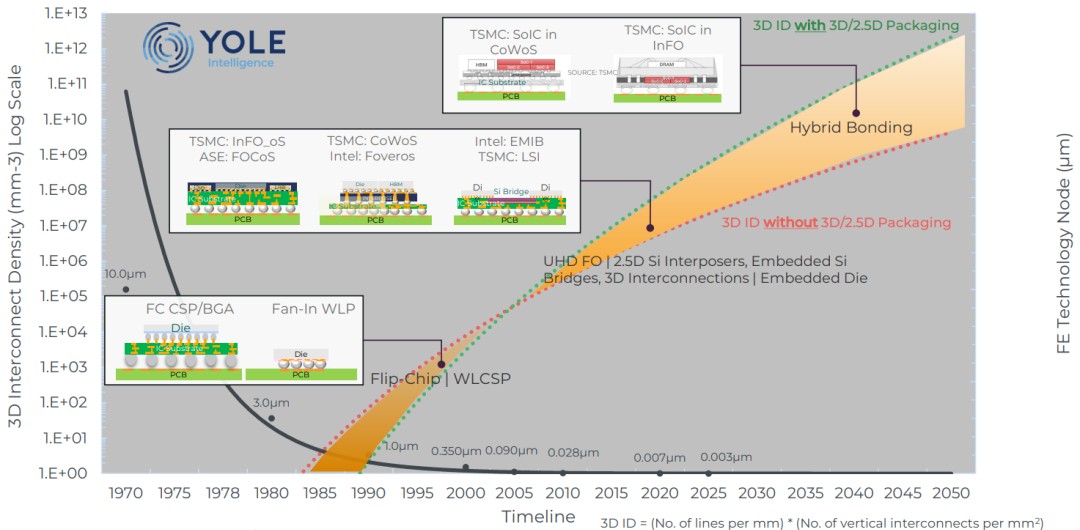
HBM requires high connection density, which cannot be met by traditional FCBGA, so 2.5D silicon dielectric layer technology is used. SoC designs are diverse, and some use 2.5D packaging to integrate SerDes and the main chip. High-end chips tend to be multi-chiplet designs, and 2.5D packaging is used to improve yield and reduce costs. TSV technology in 2.5D achieves high-density connection, which is completed by OSAT factories. Amkor leads 2.5D packaging and launches CoS and CoW platforms, which have been mass-produced since 2014 and 2018 respectively. CoS first attaches the dielectric layer and then the chip, and uses RDL First to improve yield.

CoW packaging is an upgrade of CoS, using silicon wafers as substrates. The chip is first attached to the dielectric layer, then wafer-level plastic sealing is performed, and finally the substrate is connected. Its advantage lies in the enhanced physical structure, which is suitable for large chip and dielectric layer packaging. As a TSV-free CoW variant, HDFO achieves high-density connection and low cost. It is a new trend in heterogeneous packaging and has been applied to network communications, servers, and GPU/FPGA. TSMC's CoWoS technology combines CoW and oS to improve performance, reduce power consumption and reduce size, consolidating its leadership in packaging technology. CoWoS key technologies include multi-chip integration, high-density silicon dielectric layer interconnection and efficient heat dissipation.

CoS/CoWoS Cooling Solution
CoWoS packaging dissipates heat efficiently, maintains high-performance computing stability, and optimizes heat dissipation through multi-layer heat sinks, TSV, and complex thermal management structures. Its non-gel TIM improves thermal conductivity and reliability. At high integration, CoWoS has high cost but excellent heat dissipation. CoS simplifies packaging and has low thermal resistance, but heat dissipation is limited at high power, requiring additional heat dissipation measures. Diamond heat sink materials have become a new favorite in thermal management due to their excellent thermal conductivity and other characteristics.

Diamond Heat Sink Cooling Solution
At present, semiconductor materials such as Si, SiC, and GaN have limited thermal conductivity and cannot meet the heat dissipation needs of high-power electronic devices. Diamond has become the focus of future heat dissipation solutions with its ultra-high thermal conductivity, and both single crystal and polycrystalline are superior to traditional materials. The direct connection technology between diamond and semiconductor is the key, which directly affects the heat dissipation effect. The main methods include deposition process and low-temperature bonding technology.











-

Foshan Highlight Intelligent Technology invites you to the 140th Canton Fair—join us at Booth 21.2A23-24 in the Friendship Hall to share in the brilliance.
Foshan Highlight Intelligent Technology invites you to the 140th Canton Fair—join us at Booth 21.2A23-24 in the Friendship Hall to share in the brilliance.
-
CVD Single-Crystal Diamonds: An Analysis of the Complete Processing Workflow from Gas-Phase Deposition to Finished Diamond Chips
MPCVD (Microwave Plasma Chemical Vapor Deposition) technology is currently the core process for producing high-quality single-crystal diamond s. Thanks to its advantages of low defect rates, high purity, and controllable large dimensions, it is widely used in fields such as semiconductor heat dissipation, precision optics, and high-end sensors. The final quality of single-crystal diamond s depends on comprehensive process control throughout the entire workflow—from vapor deposition growth to pos
-
Single-Crystal or Polycrystalline Diamond — Which Has Greater Potential?
As diamond continues to enter industries such as semiconductors, thermal management, optics, high-power electronics, and precision machining, the requirements for diamond materials are also evolving.
-
Diamond Polishing and Grinding Processes: Core Challenges and Industry Hurdles
Diamond is often hailed as the “ultimate material” – ranking 10 on the Mohs hardness scale, boasting an ultra‑high thermal conductivity (~2,200 W/(m·K)), excellent chemical stability, and broad optical transparency. These properties make it irreplaceable in cutting‑edge applications such as semiconductor heat dissipation, high‑end optics, and quantum chips. Yet the paradox of “good materials are hard to process” is nowhere more evident than in diamond. From rough grinding for planarization to at